
EU and German Support Crucial for Serbia’s European Integration
Jan 19, 2026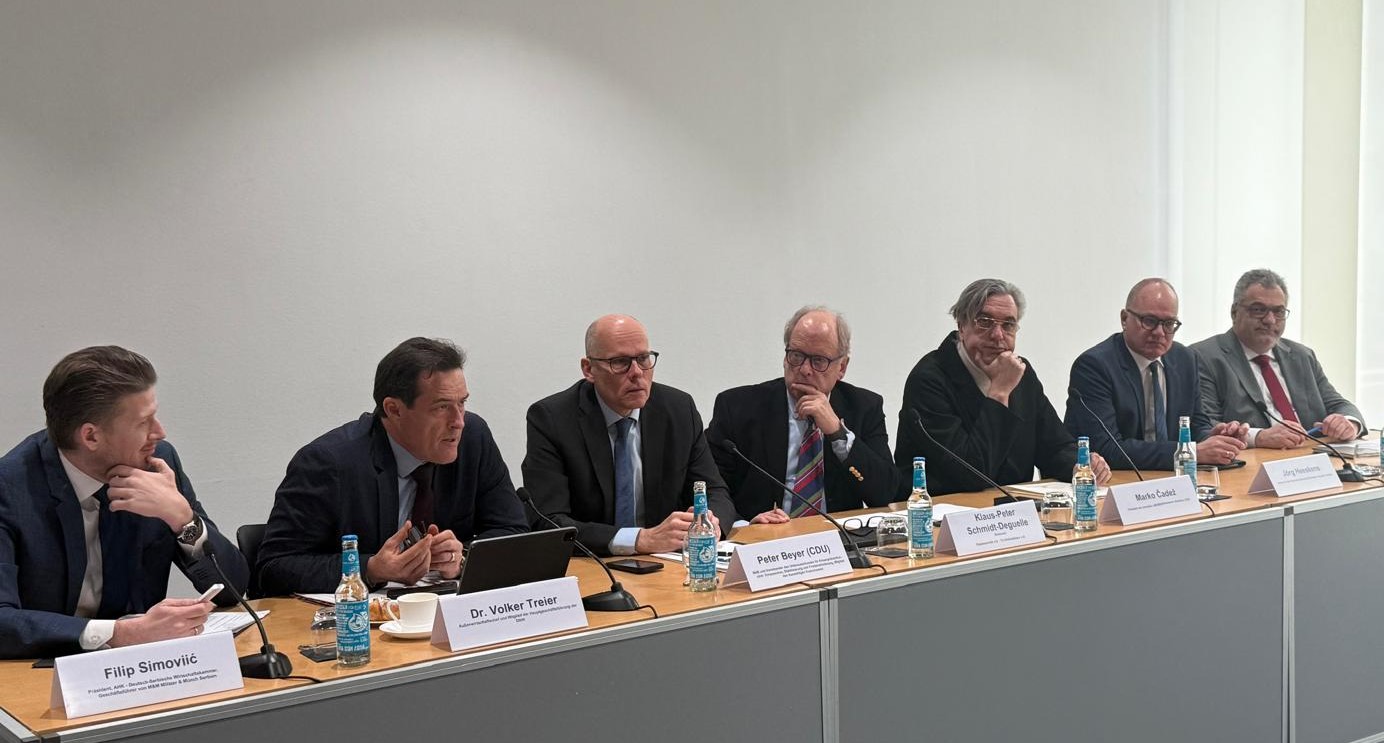
Support from the European Union and Germany, strengthening the partnership with Europe’s strongest economy and its swift recovery, is crucial for Serbia’s path toward EU accession—a process that has stagnated for years despite Serbia’s impressive economic results and the fact that integration of the Western Balkans into the EU will not be possible without Serbia.
This was one of the key conclusions of a roundtable organized last week in Berlin by the Serbian Chamber of Commerce and Industry (SCCI). Through dialogue between German and Serbian experts and an open, direct discussion with German media, the event aimed to draw attention to the historic transformation Serbia is undergoing, the structural pressures shaping Serbian policy, the role the EU and Germany must play in the accession process, and the consequences should such support be lacking.
“Urgently integrating Serbia and the region into the EU single market—even before full EU membership—is important not only for Serbia and the region, but also for European and German companies operating here,” said Marko Čadež, President of the Serbian Chamber of Commerce and Industry.
As he explained, Serbia conducts around 60 percent of its total trade with the EU, exports 16 percent of its total global exports to the German market and nearly a quarter of its exports to the EU. German companies, which have invested billions of euros in the Serbian economy, along with local firms, are equally bearing the costs of problems arising from delays in integrating Serbia and the region into the EU.
“Full access to the single market even before EU accession is, in fact, a solution proposed by the Western Balkans business community—one that no government in the region would reject,” said the SCCI President when responding to journalists’ questions about “light membership.”
Viewing Serbia’s reality and European integration from a political perspective, Peter Beyer, CDU member of the Bundestag and Chair of the Subcommittee on Crisis Prevention, Strategic Foresight, Stabilization and Peacebuilding within the Foreign Affairs Committee, sees Serbia as a “key country in the Western Balkans” and warns of the danger of Europe turning its back on it.
“If we abandon Serbia, we will see the strengthening of foreign powers that do not share our values right in the heart of Europe,” Beyer believes, noting that the “appetite for EU enlargement has diminished” and that the Berlin Process launched by Angela Merkel—aimed at bringing the region closer to the EU—was practically dormant for several years.
Limited membership, according to Beyer, should only be a transitional step: “In the end, there must be full membership, with all rights and obligations. Otherwise, the EU’s credibility would be undermined.”
Unlike current European policy, which, despite promises, has postponed the accession of Serbia and the region for two decades, shifting the focus from achieved economic progress to the political arena, representatives of German business have no such doubts. They reminded German journalists that Serbia is not only the largest, but also the strongest and most advanced economy in the Western Balkans—the only one with an investment-grade rating—whose investment performance and economic strength equal that of the rest of the region combined.
Serbia is an important manufacturing location and supplier for the German automotive industry, sharing with it the challenges this sector faces in Germany. German companies have invested nearly four billion euros in Serbia, employ more than 80,000 people, and—most importantly—88 percent of all German investors would invest again in the Serbian economy, pointed out Dr. Volker Treier, Member of the Executive Board and Head of Foreign Trade at the German Chamber of Industry and Commerce (DIHK).
Filip Simović, President of the German-Serbian Chamber of Commerce (AHK) and Managing Director of M&M Militzer & Münch in Serbia, confirmed Serbia’s importance as an investment destination for German business for multiple reasons—from its geographical position to a skilled and motivated workforce. Volker Hagen, Head of Strategic Planning at Brose, a company that has been manufacturing in Pančevo for years, said he had “nothing but recommendations for investing in Serbia.”
“Serbia is the locomotive of the region, whether we like it or not. But we should like it,” observed Jörg Heskens, advisor to Serbian President Aleksandar Vučić.
According to Heskens, Serbia’s economic progress—the fact that over the past ten years it has recorded the highest economic growth in Europe, that 90 percent of its trade is conducted with the EU and the region rather than with Russia, China, or the United States, and that it serves as a regional hub for German and European companies—should be the key anchor for accelerating European integration, just as it is the main pillar of Serbian policy.
“In Serbia, two million people vote for the president because their economic situation is better, not because they watch those ‘strange’ television channels,” Heskens said, responding to the simplified image of Serbia often presented by Western politics and media, which fails to take Serbian realities into account.
Photo: Olivera Papestiјević
LATEST NEWS
