
Strong Serbia–Hungary Ties for the Benefit of the Economy and Citizens
Feb 27, 2026.jpg)
The Serbian–Hungarian Business Forum, held today in Belgrade, brought together more than 200 business representatives from 117 companies across almost all sectors of the economy. Addressing the participants, Marko Čadež, President of the Chamber of Commerce and Industry of Serbia, emphasized that the strong turnout of business leaders sends a clear message of robust interest in strengthening economic cooperation between Serbia and Hungary.
“It is my great pleasure to welcome all participants of the Serbian–Hungarian Business Forum and to thank the ministers for including this event in the agenda of the Joint Commission for Economic Cooperation of our two countries. Bilateral trade reached EUR 3.4 billion last year, placing Hungary among our top five foreign trade partners. Nearly 4,500 Serbian companies trade with Hungary, and they are naturally interested in that market,” said Čadež.
_960x540.jpg)
Hungarian investments in Serbia have exceeded EUR 1.5 billion, and the forum is expected to further stimulate a new investment cycle. New areas of cooperation are also opening in high technologies, with opportunities for technological partnerships, digitalization, industrial transformation, and the application of artificial intelligence in business, Čadež added.
A particularly important step is the signing of the Memorandum on Financing Small and Medium-Sized Enterprises, which introduces a new support instrument for the SME sector. Agreements and deals reached at the highest level are expected to translate into concrete business activities, investments, and new jobs.
According to Čadež, good-neighborly relations between Serbia and Hungary are at their highest level and provide a strong foundation for further strengthening economic cooperation. Accelerated implementation of ongoing and the launch of new infrastructure projects are expected, which will further facilitate trade and cooperation between the two countries.
Čadež noted that companies present at the forum included YUMIS, Vital, Strela, Zdravo Organic, Biosil, Grah Automotive, RESOR, Millennium Team, Agromehanika, as well as component manufacturers and representatives of the banking sector.
Additional opportunities for cooperation are emerging in the automotive industry, bearing in mind the arrival of Stellantis in Serbia, as well as investments by Chinese electric vehicle manufacturer BYD and battery producer CATL in Hungary. This creates opportunities for Serbian and Hungarian companies to be integrated into supply chains for both conventional and electric vehicle production.
Čadež invited Serbian and Hungarian businesspeople to take advantage of the opportunity for networking, exchanging information, experience, and knowledge, and for concluding new business deals, with the support of the governments and chambers of commerce of both countries.
Mesarović: We Will Present Our Automotive Industry in Budapest

Speaking at the forum were also Adriana Mesarović, Deputy Prime Minister of Serbia and Minister of Economy, and Péter Szijjártó, Hungary’s Minister of Foreign Affairs and Trade.
Mesarović announced that on 19 March, a presentation of Serbia’s automotive industry will be organized in Budapest for major brands producing vehicles in Hungary.
“As an automotive industry and as a country offering a predictable and incentive-based business environment, we can integrate into supply chains that represent a significant development opportunity,” said Mesarović. She added that she would lead around 20 automotive companies that will present their capacities, opening space for attracting new foreign direct investments.
Szijjártó: Border Controls Will Be Reduced to a Minimum
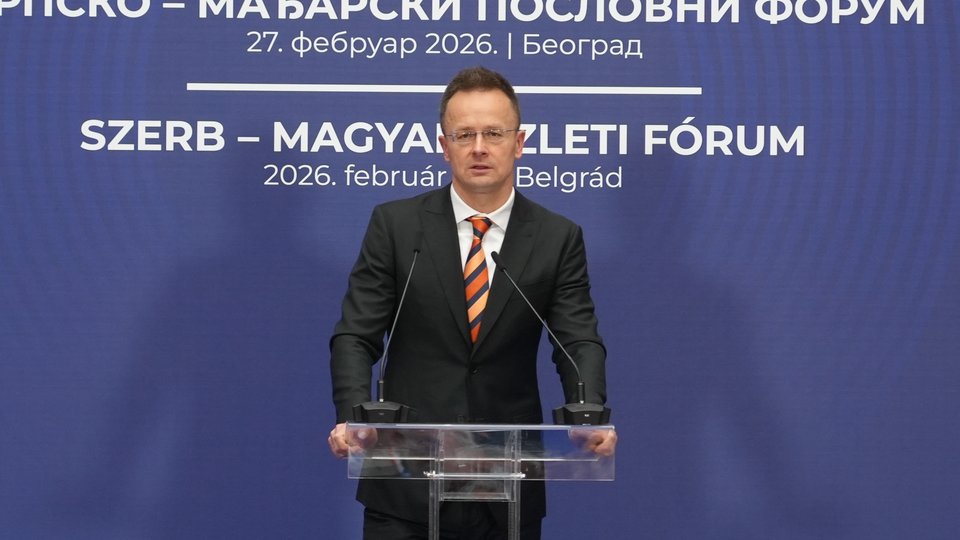
Hungarian and Serbian railways will launch passenger traffic between the two countries on the Belgrade–Budapest high-speed line no later than 27 March, said Szijjártó, adding that border controls will be reduced to a minimum and organized so as not to significantly affect travel speed.
He recalled that freight rail traffic on the new Budapest–Belgrade line started today, emphasizing that this connects a port in southern Europe with western Europe, making the route via Serbia the fastest and most efficient.
Ten freight trains will now operate daily between the two cities, with an increase to 16 trains per day expected in March, including four that will also connect the Vienna–Budapest section, thereby establishing a direct Vienna–Belgrade line, Szijjártó explained.
Following the plenary session, more than 150 bilateral business meetings were held on concrete projects in sectors ranging from energy and infrastructure to consulting and ICT.
According to data from the Statistical Office of the Republic of Serbia, total merchandise trade with Hungary in 2025 amounted to EUR 3.4 billion. Exports reached EUR 1.5 billion (an increase of 7.5%), while imports totaled EUR 1.9 billion (up 13.6%). The trade deficit stood at EUR 371 million, with export coverage of imports at 80.5%. Data from the Serbian Business Registers Agency show that 660 active business entities in Serbia are majority-owned by Hungarian legal entities and individuals.
Chambers of Serbia and Hungary Jointly Supporting SMEs
A Memorandum of Cooperation on the implementation of the Hungarian SME support program in Serbia was signed today at the Palace of Serbia between the Chamber of Commerce and Industry of Serbia, the Hungarian Chamber of Commerce, and the Confederation of Hungarian Businessmen. The memorandum was signed by Nenad Đurđević, advisor to the President of the Serbian Chamber, and Péter Kárpáti, formalizing a new phase of institutional cooperation between Serbian and Hungarian business associations.
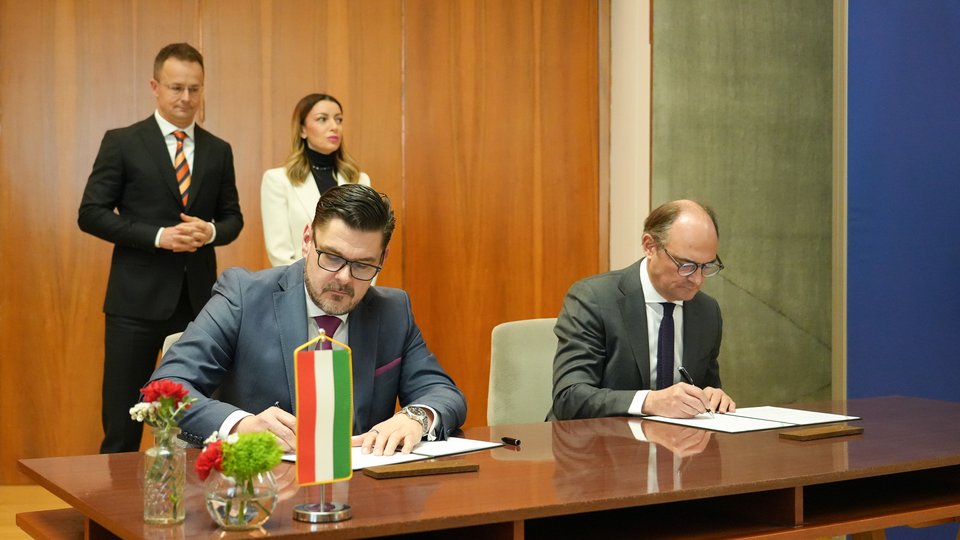
“The Memorandum establishes a framework for cooperation in developing financing models for SMEs in Serbia based on the Hungarian example. This involves developing a type of credit line for small and medium-sized enterprises that face the greatest challenges in accessing finance,” said Đurđević.
He noted that under the Hungarian model, which has provided more favorable SME financing for over two decades, the chamber of commerce, together with the government, approves and helps qualify funds.
“In order to establish such a fund in Serbia, it is necessary to assess the possibilities for adapting and implementing this model. A feasibility study is planned for the first half of this year. Hungarian experience in supporting small businesses in Vojvodina is particularly valuable in this assessment,” Đurđević emphasized.
The Memorandum is concluded for a three-year period and represents an expression of joint intent to further develop strategic cooperation and improve economic relations between Serbia and Hungary.
Photo / Video: Boban Ristić, PKS
LATEST NEWS
